Guide 2: Executive Internships — Domestic Departments and the White House
Purpose: When to apply for an internship, how you should prepare, and what's out there
Scope: eleven departments (Agriculture, Commerce, Education, Energy, HHS, HUD, Interior, Labor, Transportation, Treasury, Veterans Affairs) plus the White House and the Executive Office of the President.
An outside observer might reasonably assume that the executive branch’s hiring process would be simpler and more standardized than its legislative counterparts. By and large, that observer would be terribly mistaken. This guide exists to help you, the reader, navigate inconsistent timelines and opaque requirements on the way to obtaining an internship.
The most significant difference between the executive and legislative branch internship programs is partisanship. Unlike congressional internships, which are generally openly partisan, most executive branch internships are not. Most interns for the executive branch are hired through the Pathways programs, explained in Section 1, which mandates that appointments are made "without regard to political, religious or labor organization affiliation or non-affiliation," and must rest solely on job-related factors. Notably, this extends into the job itself; the 1939 Hatch Act restricts partisan political activity by paid federal employees, including paid interns — no soliciting campaign contributions, and no political activity while on duty.
The Executive Office of the President is the primary exception. The EOP is the set of offices that serve the President directly — the White House Office, the Office of Management and Budget, the Council of Economic Advisers, the Trade Representative, and several others. Most of these are staffed by career civil servants like any other department, but the White House Internship Program runs its own application with its own selection criteria. Section 2 covers what they ask for.
As a final note, although I studied past and current application cycles, for any given role the best and most current information is on the program's own page. As with congressional internships, I strongly advise against relying on AI for deadlines and requirements.
Section 1: The Departments
General information
Departments are permanent organizations created by Congress to carry out federal law. Congress writes the statute and appropriates the money; the department administers the result — running the programs, writing the regulations, and enforcing the rules. Each is led by a Secretary nominated by the President and confirmed by the Senate, and those Secretaries make up the majority of the Cabinet.
Leadership turns over with each administration. Political appointees number roughly 4,000 across the entire federal government, against about two million civilian employees. Everyone else is career civil service, traditionally hired on merit alone and staying across presidencies. Most interns work under career staff, though a placement in a Secretary's immediate office or a communications shop could be more political.
The vast majority of personnel and operations affiliated with each department aren’t in DC, but with regional offices spread throughout the country. Veterans Affairs alone runs internships at more than a hundred locations. For the reader interested in non-DC roles, I’ll leave the following brief advice:
Field roles are mostly found through Pathways postings on USAJOBS, which you can filter by duty station. A few of the programs listed below place students outside Washington through their own applications instead.
The work differs from DC roles. Essentially, if headquarters offices write regulations, regional offices enforce them.
It’s reasonable to assume that DC roles are generally more competitive.
Returning to DC roles, departments primarily hire interns in two ways.
The first is in the form of a traditional named program — e.g., the Transportation Secretarial Internship Program, the NIH Summer Internship Program, or Treasury's law internship. You apply to the program rather than to a particular job, you start alongside a cohort, and there is usually an associated experience: an orientation, a speaker series, or a final presentation. These internships are conducted independently by each department and are accessible through each department's website. Information and timelines for each are located at the bottom of this section.
The second is a single, independent job posting. Departments often will introduce an internship position sporadically, in response to a particular need. These postings can be found on USAJOBS — intern.usajobs.gov. This portal generally will not show named programs.
Most opportunities within this latter route run through the Pathways program.
Ordinarily, getting a federal job means a long formal competition — the position is announced, applicants are scored against published criteria, and the office hires off a ranked list. Pathways was created by executive order in 2010 and is run by the Office of Personnel Management to simplify that process for student interns. Some programs use other authorities — Transportation's Secretarial Internship Program runs on the Post-Secondary Hiring Authority, and NIH's summer program is a research training placement rather than a federal appointment.
Paid Pathways positions sit on the General Schedule, the pay scale covering most federal office work. It runs from GS-1 to GS-15, and interns generally come in between GS-4 (~$20 per hour in DC) and GS-7 (~$28) depending on how far along they are in school. Some programs pay a stipend instead. While most are, not every position is paid — the Treasury's law internship, for instance, and the student volunteer programs at Education and HUD are unpaid.
Unlike many congressional roles, U.S. citizenship is generally required. Moreover, an intern who completes 480 hours becomes eligible for non-competitive conversion to a permanent position, or 320 with a waiver; no comparable path exists for the legislature.
Some internship programs are capped, limiting the number of applicants and potentially closing before the deadline. Departments may also demand certain procedural particularities; the Treasury department, for instance, demands that applicants submit their application by email and through USAJOBS.
Summer roles
Applications open between early August and mid-February.
Deadlines run from early October to mid-February, clustering in January.
The earliest is Interior's, which closes in early October — eight months before the session begins.
Fall roles
Applications open between early March and mid-June.
Deadlines run from early May to late July, clustering in May and June.
Spring roles
Applications open between early June and early September.
Deadlines run from early August to early December.
Programs and timelines
Deadlines checked August 2026. Departments publish these on their own schedules and several reorganized their career pages this year, so act with some caution. I listed as many positions as I could, but this is not a complete census of all available opportunities. Programs are grouped by where they place you and who they're open to; within each group, the ones that publish a calendar come first.
Washington and the surrounding area
Health and Human Services — NIH Summer Internship Program. Opens mid-November and closes mid-February. Reference letters are accepted a week past the deadline. Applications go through the NIH Application Center. Based in Bethesda, with placements on other NIH campuses as well.
Education — student programs. The Pathways internship opens in mid-February for summer and mid-June for fall, stays open five days, and is capped at 200 applications. The unpaid Student Volunteer Trainee Program runs early May to late July for fall, and early September to late November for spring.
Housing and Urban Development — Student Volunteer Program. Unpaid, with fall applications due in late June, submitted by email.
Treasury — Headquarters Student Internship Program. Unpaid, open from high school through graduate level. No deadline published.
Transportation — Secretarial Internship Program. Ten weeks, paid, summer only, and you must be able to work in the DC metro area. No deadline published.
Legal internships, for law students
Interior — Office of the Solicitor. Internships and externships at headquarters in Washington and at regional offices. Fall opens early March and closes early May. Spring opens early June and closes early August. Summer opens early August and closes early October for second- and third-year law students, and opens early December and closes mid-January for first-years.
Education — Office of General Counsel. Closes in early December for spring, early January for summer, and late June for fall. Education runs broader legal internship programs as well, open to law students and some undergraduates.
Treasury — Law Student Internships. Unpaid, ten weeks, across about twelve counsel offices in Washington. Reviewed on a rolling basis, which in recent cycles has begun in early January. Requires both a USAJOBS application and an email; Treasury states that applicants who submit only one may be excluded.
Labor — Office of the Solicitor. Nine divisions at the Washington national office take interns and externs. No deadlines are published; applicants contact divisions directly.
Transportation — Office of Inspector General. Unpaid volunteer internships with the Office of Chief Counsel and the Office of Investigations. No deadline published.
Programs outside Washington
Energy — Science Undergraduate Laboratory Internships. Summer opens late October and closes early January. Fall opens mid-March and closes mid-May. Spring opens early July and closes late September. Offers begin two to four weeks after each deadline. Placements are at the national laboratories.
Commerce — NOAA Hollings Undergraduate Scholarship. Opens in September and closes in January. Up to $9,500 a year for two years of study, plus a ten-week paid summer internship at $700 a week, a housing subsidy, and travel funds. About 120 students a year. The internship is at a NOAA facility, which may be anywhere in the country.
Agriculture — 1890 National Scholars Program. Pairs a scholarship with summer USDA internships for students at the 1890 land-grant universities. Closes in early March.
Interior — National Park Service. Heritage Documentation summer internships close in early March, and paid partnership internships of ten to thirty weeks run with the National Council for Preservation Education. Work is at park and heritage sites nationwide.
Veterans Affairs — National Diversity Internship Program. Paid. Spring runs January to May and fall September to December, fifteen weeks each; summer runs June to August, ten weeks. Applications go through an approved outside organization rather than to VA, and each sets its own deadline, so there is no central date to cite. VA also runs the Workforce Recruitment Program and the Graduate Healthcare Administration Training Program.
Section 2: The White House and the Executive Office of the President
General information
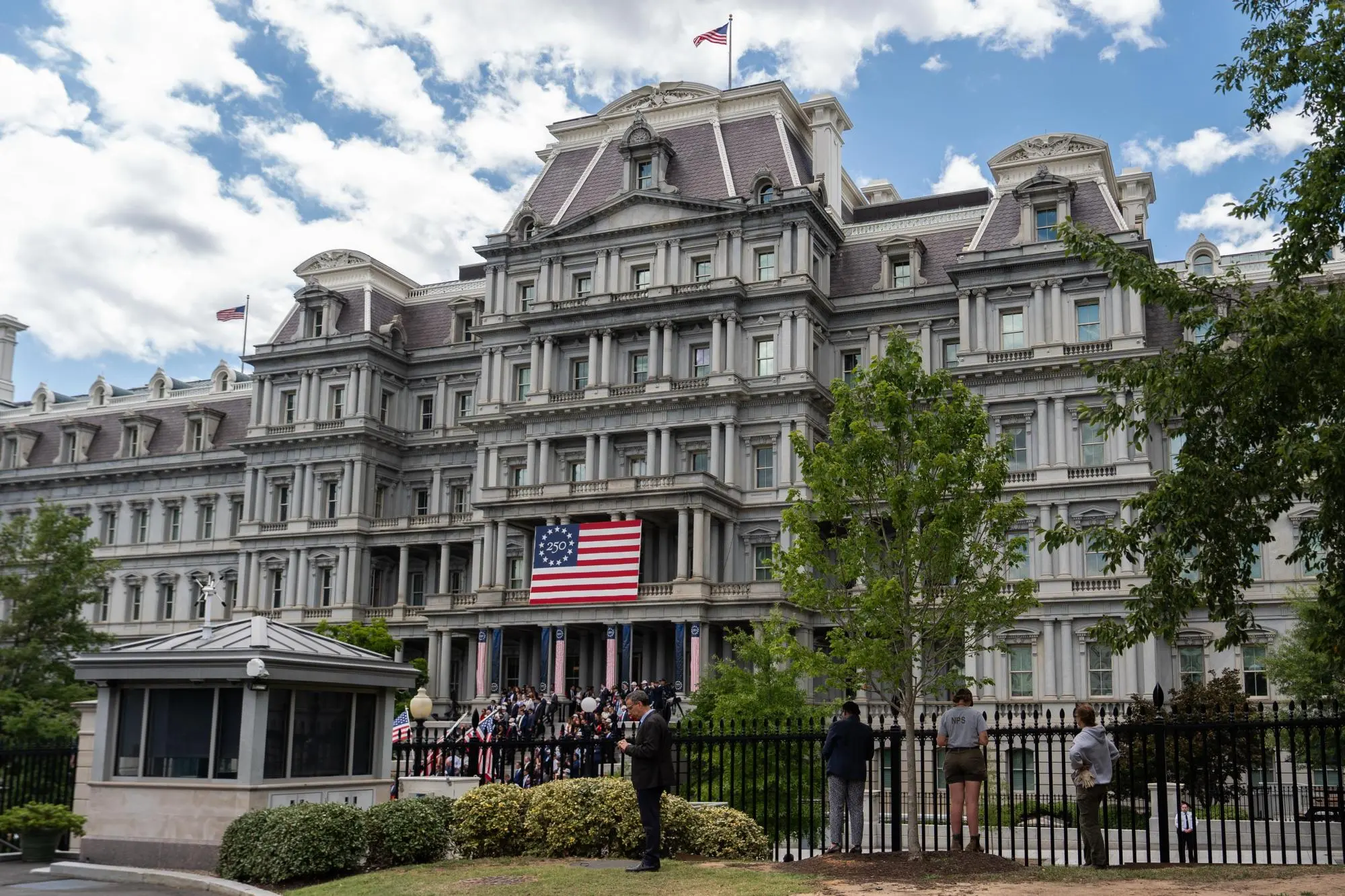
Unlike the departments covered in Section 1, which are generally large operating organizations home to tens of thousands of employees and offices across the country, the Executive Office of the President is smaller and centered on the functioning of the White House itself. Offices within the EOP advise the President, write budgets, and coordinate policy across departments, but they don't administer that policy themselves. Most EOP staffers work in the Eisenhower Executive Office Building, next to the West Wing.
The largest single application portal is the White House Internship Program. It's one application, and it lets prospective interns rank their top choices across dozens of offices, including the National Economic Council, communications and press, and the Office of the First Lady. Requirements and acceptance rates vary by office, with responsibilities ranging from advising the President on legal questions at the Office of White House Counsel to opening his mail at the Office of Presidential Correspondence. Not a lot of publicly available information exists regarding this program, so I may eventually publish a separate guide once I can collect more. Feel free to reach out if you're reading this, and you know anything.
The White House Internship Program is unpaid. It was paid briefly — a 2022 spending bill funded stipends of $750 per week, the first time in its history — but the current administration reverted it. Housing is not provided, and any outside income, funding, or housing assistance requires pre-approval, since federal ethics rules restrict outside parties from paying for government work. Sessions run 10 to 12 weeks in spring, summer, and fall, in person, Monday through Friday from 9:00 a.m. to 6:00 p.m. Interns must work at least 4.5 days a week to count as full time, with limited exceptions for class requirements.
Applicants must be U.S. citizens, at least 18 years old, and must pass drug testing and security screening. Currently enrolled undergraduates and graduate students qualify if they have completed two semesters by the start date, as do anyone who graduated within the past two years and veterans who served on active duty in that window.
The White House cites three factors in selection: a commitment to public service, demonstrated leadership in the community, and a commitment to the mission of the Trump Administration. Although the White House denies that political preference itself decides the review, that claim can reasonably be taken with a healthy dose of salt.
Reviewers read applications on a rolling basis, which advantages earlier applicants. Recommendation letters are required, must arrive through the portal as PDFs, and are penalized if late.
Summer roles
Applications post in early December and close in early January — a four-week window.
Acceptance notifications begin in mid-February, roughly six weeks after the deadline.
The session runs from early June to early August.
Fall roles
Applications post in early March and close in early April — a four-week window.
Acceptance notifications begin in mid-May.
The session runs from early September to mid-December.
Spring roles
Applications post in mid-July and close in early August — a four-week window.
Acceptance notifications begin in late September.
The session runs from mid-January to early May.
Section 3: Other Programs
Outside organizations
Some organizations run their own applications and place participants into federal agencies rather than hiring them directly. Some examples are included below:
HACU National Internship Program — paid ten- and fifteen-week internships at federal agencies, in Washington and around the country. Running since 1992, with more than 10,000 students placed.
ORISE — manages paid research internships and fellowships for Energy, Health and Human Services, Defense, Homeland Security, and other agencies. Opportunities are listed on a searchable portal called Zintellect rather than USAJOBS, and each one has its own timeline. Heavily science and technology.
Washington Internships for Native Students — run through American University for American Indian and Alaska Native students. Placements are all in the DC area and carry six academic credit hours. The student deadline is generally the first week of April.
Deadlines here sit much closer to the session than their congressional equivalents. HACU's fall applications close in mid-July for a September start — about two months of lead time, against the four to six months that sponsored congressional programs often require.
Elsewhere in the executive branch
This guide covers eleven departments and the White House. State, Defense, Justice, and Homeland Security run on longer timelines driven by security clearance and are covered in Guide 3; independent agencies including NASA, EPA, the SEC, and the Smithsonian are in Guide 4; federal courts are in Guide 5.
Section 4: Other Useful Information
Security clearance is generally not required across these eleven departments, though some Treasury and Transportation roles need it and processing runs months rather than weeks. The national security guide covers this properly.
Pathways appointments may be temporary or indefinite. Temporary runs up to one year and can be extended in one-year increments.
Pathways requires applicants to be at least 16 and enrolled at least half-time, and to remain enrolled for the whole appointment.
Paid interns are federal employees and subject to the Hatch Act. Unpaid interns generally are not.
The White House requires drug testing and security screening. Most departments do not.
Federal hiring is subject to freezes, reorganizations, and administration-level changes in a way congressional hiring is not. Several departments moved or retired their student pages during 2026, and Education is currently transferring offices to other agencies.
Bibliography(11)
- Pathways eligibility, nonpartisan hiring language, appointment length, and the 480-hour conversion threshold (320 with a waiver): Office of Personnel Management, Pathways Programs; Executive Order 13562, December 2010; 5 CFR Part 362, revised regulations effective June 2024.
- General Schedule pay range and the GS-4 and GS-7 hourly figures: OPM, 2026 General Schedule salary table, Washington-Baltimore-Arlington locality area.
- Number of political appointees relative to civilian employees: OPM Plum reporting and the Center for Presidential Transition.
- Hatch Act restrictions on paid federal employees, and the exemption for unpaid interns: U.S. Office of Special Counsel, Hatch Act FAQs.
- Where single job postings appear and how they are filtered: intern.usajobs.gov, the federal internship portal.
- White House office count, unpaid status, hours, session length, housing, eligibility, screening, selection criteria, rolling review, recommendation letter policy, and all session dates: whitehouse.gov internship overview, Presidential Departments, Applicant Criteria, FAQs, and How to Apply pages, checked August 2026.
- The $750 weekly stipend and its status as the first in the program's history: White House announcement of the first paid internship class, 2022.
- Pre-approval requirement for outside income, funding, or housing assistance: whitehouse.gov FAQs; 18 U.S.C. § 209.
- Department program deadlines, terms, and locations: program pages linked in Section 1 — Interior, Energy, Health and Human Services, Commerce, Education, Treasury, Labor, Transportation, Housing and Urban Development, Agriculture, and Veterans Affairs, all checked August 2026.
- Third-party placement program terms and deadlines: HACU, ORISE, American University's Washington Internships for Native Students.
- Relative competitiveness of DC versus regional roles, and variation in acceptance rates across White House offices: personal experience.